Connect with us

ENGLISH

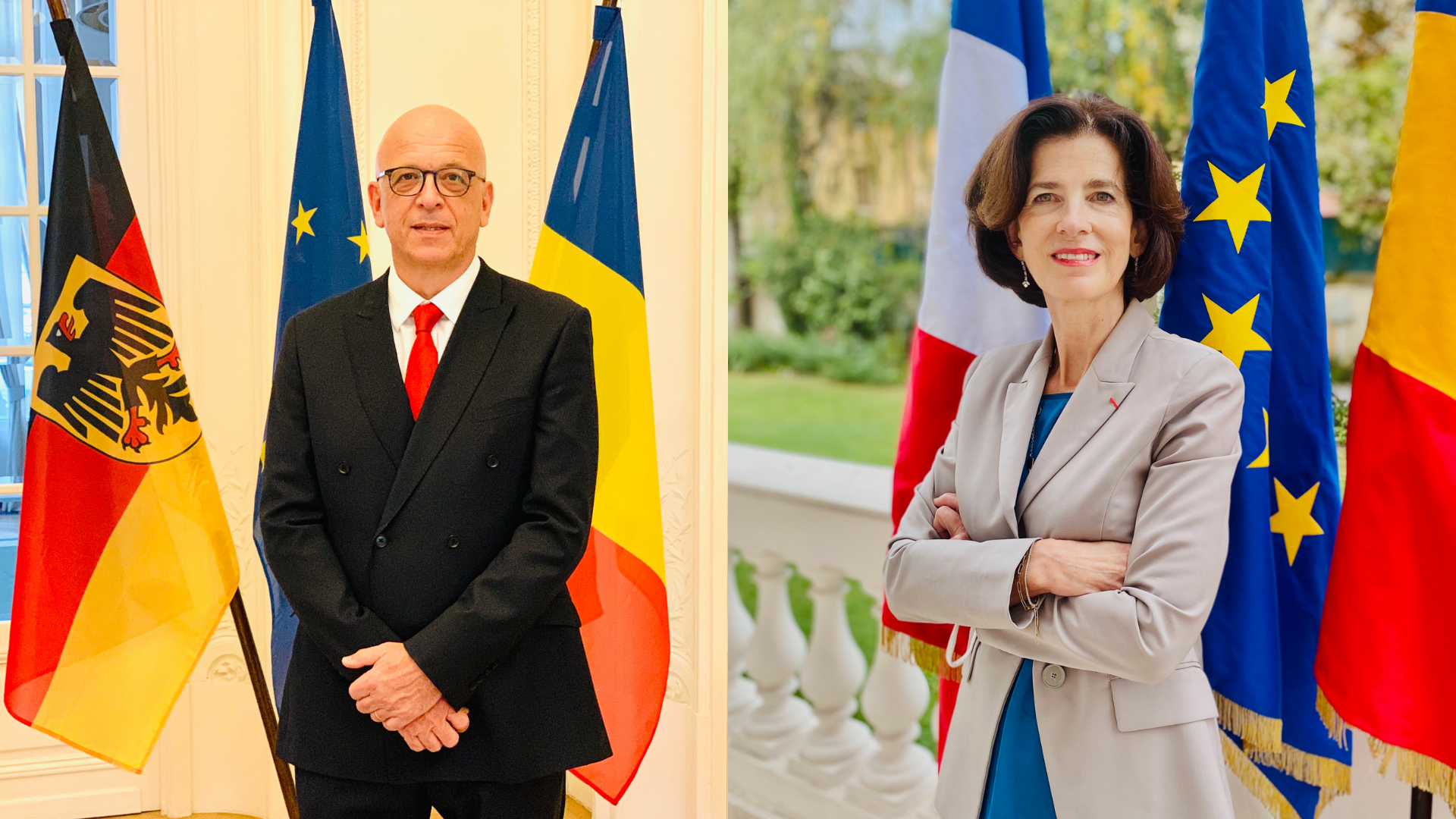
French-German Day. Ambassadors Laurence Auer and Cord Meier-Klodt: Europe was made possible because two countries decided to reconciliate. The spirit of the Elysée Treaty shaped EU’s recovery fund

Published

on

© Photo Collage (Official Embassy images)

Interview conducted by Dan Cărbunaru and Robert Lupițu

As everywhere in the world conflicts and tensions multiply, the main achievement of France and Germany is still to have brought more peace and prosperity to our European continent, and based on a living legacy of historical ties with Romania the three countries are building a common European future today, Laurence Auer and Cord Meier-Klodt, ambassadors of France and Germany to Romania said in an joint interview given exclusively for CaleaEuropeană.ro on the occasion of the 58th anniversary of the historic Franco-German reconciliation.

58 years after the signing of the Elysée Treaty by President Charles de Gaulle and Chancellor Konrad Adenauer, who laid Franco-German relations on new European foundations, and two years after the new impetus for this partnership by the Treaty of Aachen, signed by President Emmanuel Macron and Chancellor Angela Merkel in the presence of President Klaus Iohannis as representative of Romania’s Presidency to the EU Council, France and Germany offered a new show of unity, friendship and cooperation when Europe needed it most: a compromise that formed the basis of the € 750 billion recovery fund to relaunch the European Union following the COVID-19 pandemic, the biggest crisis since the European project was founded.

“The plan is called Next Generation EU because we believe that we need to address the future of all European citizens, not only short term consequences of the pandemic” said Laurence Auer, France’s ambassador to Romania, praising the work of the German presidency of the EU Council, which ended on 31 December 2020.

“It was not easy and the road was difficult, but at the end of the road there was consensus. (…) We can even say that the spirit of the Elysée Treaty was the one that drew the course of the agreement later”, Cord Meier-Klodt added, in a symbolic reference to the fact that the historical milestones of Franco-German cooperation materialized through the “spirit of the Elysée” and the “spirit of Aachen”.

The two ambassadors also set out their countries’ views on the Conference on the Future of Europe and the fact that it “aims to build on the 10 commitments for the future of the EU that were agreed in the 2019 Sibiu Declaration”, also arguing for a continuation of the close relations with Romania.

Referring to the future ambitions of the French Presidency of the EU Council, which will begin on 1 January 2022, Laurence Auer welcomed Romania’s support in including the rule of law as part of the future Multiannual Financial Framework: “The rule of law in the EU is not an ideology, it is a set of legal rules, it is the heart of the political contract that binds us”. Equally, Cord Meier-Klodt stressed that France and Germany would be happy to welcome Romania among the eurozone member states.

Laurence Auer and Cord Meier-Klodt also emphasized the importance of the European Union’s strategic autonomy, as well as the broad transatlantic agenda between Europe and the US with the inauguration of the Joe Biden administration.

Konrad Adenauer and Charles de Gaulle at the signing of the Elysée Treaty, 22nd of January 1963. © Wikipedia

CaleaEuropeană.ro: It’s been 58 years today since the signing of the Élysée Treaty that brought the Franco-German reconciliation at the heart of the European construction. Two years ago, stepping on the foots of presidents de Gaulle and Mitterrand and chancellors Adenauer and Kohl, President Macron and Chancellor Merkel reinforced the European cooperation between the two EU powers with the Aachen Treaty. What are the main milestones born from this historical reconciliation and what can the future possibly lie ahead?

Laurence Auer: As we celebrate the anniversary of the Élysée treaty, it is important to remember that Europe was made possible because two countries which fought in devastating wars decided to reconciliate and build a system that would forever prevent new wars. Attention was paid to cross-border relations, to a better mutual understanding, to the learning of each other’s language. Today, as everywhere in the world conflicts and tensions multiply, the main achievement of France and Germany is still to have brought more peace and prosperity to our European continent.

Angela Merkel and Emmanuel Macron a the signing of the Aachen Treaty, 22nd of January 2019 © Bundesregierung

The 2019 Aachen Treaty on Franco-German cooperation and integration represents a new step in deepening the links between the two societies. It created an Economic council of experts, a joint information platform, a Franco-German Parliamentary Assembly and a new fund for citizens that fosters projects between civil societies.

Moreover, as we face the multiple effects of the health crisis, I must stress that it is after a Franco-German initiative that the European recovery plan was proposed. We should praise the immense work of the German Presidency of the EU that made possible the decision of all member states to allocate €750 billion in order to rebuild our economies. The plan is called Next Generation EU because we believe that we need to address the future of all European citizens, not only short term consequences of the pandemic.

CaleaEuropeană.ro: The signing of the Aachen Treaty in 2019 took place in a broader European context with Romania at the helm of its first EU Council Presidency. The spirits of Élysée and Aachen were adopted by President Iohannis under “the Sibiu Spirit” inked in 9th of May EU Summit Declaration. Has the European Union and its member countries lived up to the commitments enshrined in these spirits across the most difficult challenges in its history – the COVID-19 pandemic?

© Administrația Prezidențială

Cord Meier-Klodt: First of all, I particularly liked that the reaffirmation and revision of the Elysée Treaty in 2019 took place during Romania’s Presidency of the Council of the European Union, thus benefiting from the special appreciation from a partner state in Southeast Europe.

Secondly, no one says that the response to the COVID-19 pandemic went smoothly and without crises. Neither in Member States nor at the level of the European Commission. Especially in the early stages! In fact, no one was prepared for a crisis of this magnitude.

Taking all this into account, I believe that Europe has proved its capabilities in this very crisis. Only if we look at the unprecedented € 750 billion post-COVID-19 “Next Generation Europe” Economic Recovery Plan adopted during the German Presidency of the EU Council. The procurement of vaccines by the European Commission has also been particularly important.

Who would have thought in the spring of 2020 that Member States would be able to agree on € 390 billion in non-reimbursable funds? It was not easy and the road was bumpy, but at the end of the road there was consensus.

This was only possible because Germany and France, Federal Chancellor Merkel and President Macron, had already agreed in May 2020 on a compromise that was the basis for the agreement that followed. We can even say that it was the spirit of the Elysée Treaty that shaped the course of the agreement later.

CaleaEuropeană.ro: The 750 billions EUR recovery fund is the most recent and tangible result of Germany and France being the engine that fuels a compromise between the EU-27. What kind of example does this EU-27 agreement set for the future of the European integration in political terms but also in the perspective of an in-depth fiscal and economic integration?

Cord Meier-Klodt: The German-French initiative, which has resulted in an unprecedented recovery package for Europe, has made it very clear that European solidarity is not just an empty word. Romania alone obtained 30 billion euros for the post-pandemic economic recovery. Of course, this financial aid also imposes political obligations: the rule of law and democratic values ​​are basic conditions for being able to use European funds. In this context, I welcome the announcement made by Prime Minister Florin Cîțu to quickly fulfill the remaining recommendations regarding CVM. 

With this compromise – difficult to negotiate, as we must admit – the EU has shown that it can reach an agreement and that it is fully operational, despite the very different positions initially expressed. This is also an important signal regarding our capacity for action on the international stage.

In terms of financial and economic integration, we all know that for deeper integration we need greater convergence between Member Sates. That is why the EU offers Romania massive support in order to stimulate economic development. But it is obvious that this development cannot come “from the outside”, but that Romania must take decisive steps in this regard. The new government has made it very clear that it wants to continue on this European path.

CaleaEuropeană.ro: Deals on the Multiannual Financial Framework, Next Generation EU fund, link between EU money and the rule of law, compromise on EU climate goals, post-Brexit agreement, a principled agreement on investments with China and a political debate on EU’s strategic autonomy. All these have in common one thing – the German Presidency of the EU Council. One year from now, the French Presidency will lead the EU Council. What will be the aim for Paris and Berlin for the key European files like the Single Digital Market, the Economic and Monetary Union, the Banking Union and the resilience of the Internal Market in the years ahead?

Laurence Auer: While the German Presidency’s slogan was « Together for Europe’s recovery », we are now, for the next six months, under the guidance of the Portuguese presidency with the motto « Time to deliver: a fair, green, digital recovery ». After the difficult and uncertain times of the pandemic and after Brexit, we need to transform our budgetary decisions into concrete results for the citizens. Never was it more important to preserve unity and cohesion among the now 27 Member states and to put into force the historical decisions which were taken on December 10th.

 The French Presidency will come in 2022 with priorities, of course, in due respect of what our Portuguese and then Slovenian partners will have achieved in 2021. I should mention the rule of law, a key element of the new financial framework, adopted with the support of Romania. The rule of law in the EU is not an ideology, it is a set of legal rules, it is the heart of the political contract that binds us. Furthermore, the French Presidency will of course follow up on the implementation of the green and digital agendas. As you know, we set ourselves the goals of reducing carbon emissions by at least 55% by 2030 and reaching carbon neutrality by 2050. But no ecological transition will be possible without handling a big digital transformation of the European economies. I should add the social dimension : Europe will be stronger if we reaffirm that sustainable development goes along with innovation and inclusion. We are very happy that the Erasmus and « Horizon Europe » education and research programmes were reinforced for the next period.

CaleaEuropeană.ro: There is one special subject that was intended to be framed between the German and French Presidencies of the EU Council, namely the Conference on the Future of Europe. Mainly because of the pandemic the launch of the Conference has been postponed. What is the hope for the French-German close partnership in regards with the foreseeable results of this Conference with respect to scenarios such as treaty changes, QMV in the Council or multi-speed Europe?

© Ambasada Franței în România

Laurence Auer: The Conference on the Future of Europe is a tripartite initiative between the Commission, the Council and the European Parliament to promote dialogue between citizens, experts and institutions. It aims at building up on the 10 commitments for the future of the EU that were agreed in the 2019 Sibiu declaration. The German Presidency of the EU has accomplished a lot of work on its preparation but indeed, due to the pandemic the official launching of the conference has been postponed to the Portuguese presidency.

Fundamentally, the conference is not about experts meetings on treaty changes. It will promote a collective reflection on the meaning of «le vivre ensemble européen », on our common destiny. Its objective is to set up new priorities for concrete advances in terms of training, education, culture, mobility, etc. We want the conference to reaffirm the way of life we want to promote for the EU citizens, and reinforce our global European project.

CaleaEuropeană.ro: While thinking to the EMU and the BU we see that the highest level of EU integration today is the single currency. What would be the benefits for Romania in joining the euro area, a path already half-completed by other new member states such as Bulgaria and Croatia?

Cord Meier-Klodt: Economic and Monetary Union, as well as the Euro, aim to make the European economy work better and create more jobs – in short: to give European citizens access to more prosperity. Joining the eurozone therefore comes with economic benefits. Of course, this path must be accessible to all EU Member States.

However, membership of the eurozone also involves many responsibilities and challenges. It is a complex process, and the changeover to the euro requires extensive preparation. So any country needs to be well prepared for this transition to truly become an asset for their own development. Sound public finances and a robust and competitive economy are essential. The accession process already brings many benefits and a package of measures for economic improvement.

Of course, we would be happy, as eurozone countries, to welcome Romania, as soon as all the conditions are met, because that will strengthen the eurozone. The fact that Romania is very intensely concerned about joining the eurozone is a very good precondition for all other stages.

CaleaEuropeană.ro: Back in the 2017, when the European Parliament building in Strasbourg hosted the funerals of former Chancellor Helmut Kohl, Jean-Claude Juncker recalled the tears of Kohl in 1997 when the European Council decided to enlarge the European Union to Eastern and Central Europe. “Europe at its best”, he said. As founding countries of the European dream, how would you describe the benefits of the European integration for a country like Romania and for the European Union as a whole?

Cord Meier-Klodt: I consider that it is of a special symbolism that Romania joined the European Union in 2007 during and with the concrete support of the then German Presidency of the Council of the European Union. And I am deeply convinced that this affiliation of Romania (and of other Eastern European partners) represents not only a success for Romania, but also for Germany.

Let us remember that in the post-war period, Germany was the only Western and Eastern European country in the political sense. It was in this spirit that the “Eastern policy” (Ostpolitik), significantly promoted by Federal Chancellor Willy Brandt, emerged in the Federal Republic of Germany in the early 1970s, with its slogan “Change through rapprochement” (“Wandel durch Annäherung”).

In the same spirit, the treaties of good neighbourhood and friendship with the countries of Eastern Europe were signed at the beginning of the 90s, after the Fall of the Wall, among them Romania. These treaties were later followed by NATO and EU accession.

In short, for post-war Germany, Europe has always meant East and West, together as much as possible. And this is true to this day.

On September 25, 1984, 70 years after the start of the First World War, German Chancellor Helmut Kohl met the French president François Mitterrand in Verdun. Mitterrand extended a hand to Kohl – a gesture of friendship symbolizing the lessons learned from a frightful past. © Source: EC – Audiovisual Service/ 1984

CaleaEuropeană.ro: There is one key issue on which Foreign Minister Heiko Maas said “our French friends” were pleased during the German EU Council Presidency: putting forward the political debate on EU’s strategic autonomy. This seems like an objective of paramount importance for President Macron, who acknowledged unrest induced by terms such as “EU sovereignty” or “strategic autonomy”. In this part of Europe, it is regarded as a tendency to decouple from our allies in Washington. How do France and Germany see Europe building its strategic autonomy?

Laurence Auer: Since 1963, France and Germany have discussed a lot on these issues, at the highest level and not only to prepare EU Presidencies ! In the Aachen treaty for instance, we included a mutual defence clause, at a bilateral level.

 I want here to avoid being misunderstood : there has been a lot of debates on the concepts and of course this is an important track for the future of collective security in Europe. Security is a field with very quick evolutions, if you take for instance the cybersecurity domain.

Today, both countries are strongly committed at EU level on the implementation of the European defence fund, which was created under the new Financial Framework to build common capacities.  Romania is part of many projects designed under this fund. As a whole, I can say that France aims at strengthening Europe’s strategic credibility, and we have the same goal in a bilateral context. We have concrete challenges and we want to provide concrete answers to them. In a context of growing threats, and relations governed by power relations, we should be able to defend our interests.

© Ambasada Germaniei în România

Cord Meier-Klodt: And, if I may add, reaching even beyond the field of security policy, a sovereign Europe should entail all aspects of our European foreign policy and be reflected in a truly multilateralist approach.

CaleaEuropeană.ro: European unity cannot replace transatlantic unity. This is often said by NATO Secretary General Jens Stoltenberg while it was diminished during the difficult and tense relations between Europe and the Trump administration. However, with the oath of the Biden administration comes a signal of hope. Do France and Germany expect a “New transatlantic deal”, as it was phrased by Foreign Ministers Maas and Le Drian, and what are the hopes coming out from NATO, EU-US and G7 summits in the future months?

Laurence Auer: The arrival of a new American administration means a lot to France on all global issues, climate change, conflict resolution under the UN Framework, global governance, for instance of the pandemic under WHO, or the regulation of digital platforms, but also on all regional crises. Remember that Valery Giscard d’Estaing, a great European President, gave birth to the G7 in 1975, just one year after the European Council was created. As a former Finance Minister, he believed in a better wold regulation of the economy after a monetary crisis. At a European level we have a large agenda of transatlantic discussions. We also need to talk to our American allies about security challenges as I mentioned above. The EU and the US have many issues to work on together, including multilateralism, development, trade or conflict prevention issues. Together, the French and German ministers of Foreign affairs laid out a possible roadmap for these transatlantic discussions in the coming years.

CaleaEuropeană.ro: Finally, a zoom in your countries bilateral relations with Romania. Adding to the common European destiny and the economic exchanges, between France and Romania there is a powerful cultural and francophone link, while the Romanians in Germany and the German ethnics in Romania play a key role in our special ties. In which areas do you believe the relations between France and Romania, respectively Germany and Romania, will continue to develop in the new decade?

Cord Meier-Klodt: Both France and Germany have close historical ties with Romania. For France, the common position in the francophone world is especially important, while Germany emphasizes the traditional bridge represented by the German minority in Romania, and today by the growing community of Romanians living and working in Germany. Based on this living legacy, the three countries are building a common European future today.

In this sense, the commitment of Romanians to Europe is extraordinarily useful. Within the EU, Romania is a very important partner, which can reach compromises and convince other Member States of their need. I saw this both during Romania’s presidency of the EU Council in 2019, and, in full, during Germany’s recently concluded presidency.

I would like Romania to consciously develop this potential, because the EU needs a lot of support to face the current challenges: reinforcing democracy, tackling climate change, continuous digitalisation, foreign policy issues, relations with China and much more. We will only succeed if we agree. Partners who are able to reach compromises are more important than ever.

Laurence Auer: And if I may add, I would also insist on the fact that we share with Germany a total commitment towards the European project, a strong capacity and a will to build consensus with all our European partners, that we respect and with whom we developed strong historical ties. We will need in the next period of time to be innovative as the stakes are high. Between France and Romania, we will rely on the strong strategic partnership we have built in all sectors at the bilateral level and we will develop paths of concrete cooperation and convergence everywhere we can. I am personally fully committed towards this objective for the next three years.


Robert Lupițu este redactor-șef, specialist în relații internaționale, jurnalist în afaceri europene și NATO. Robert este laureat al concursului ”Reporter și Blogger European” la categoria Editorial și co-autor al volumelor ”România transatlantică” și ”100 de pași pentru o cetățenie europeană activă”. Face parte din Global Shapers Community, o inițiativă World Economic Forum, și este Young Strategic Leader în cadrul inițiativelor The Aspen Institute. Din 2019, Robert este membru al programului #TT27 Leadership Academy organizat de European Political Strategy Center, think tank-ul Comisiei Europene.

ENERGIE

PPC Group strengthens its green portfolio in Romania with a new photovoltaic project of 130MW at the region of Călugăreni

Published

on

© PPC

Committed to the vision to further enhance its leading role in the energy transition taking place in Southeast Europe, the PPC Group strengthens its green portfolio in Romania with a new photovoltaic project at the region of Călugăreni, 40 km south of Bucharest, which was recently connected to the grid.

For the construction of the new photovoltaic plant, 227,240 bifacial photovoltaic panels were used. The estimated annual energy generation of the project is expected to exceed 193 GWh, sufficient to meet the energy needs of more than 48,500 households. The operation of the project is expected to prevent the emission of around 116,000 tonnes of CO2 per year, according to a press release

„We remain committed to the Group’s strategy of becoming a major energy player in the wider Southeast European region. The new photovoltaic park in Romania confirms our dominant position in the Romanian renewable energy market. We continue to steadily develop our green portfolio, with geographical and technological diversification, in order to maximise the benefits of the green transition and the interconnected energy market”, stated the Deputy Chief Executive Officer of RES PPC Group,  Konstantinos Mavros.

The new photovoltaic park is part of an agreement between the PPC Group and Metlen Energy & Metals for renewable energy projects. A total of 460 MW of photovoltaic parks, part of an agreement with Metlen Energy & Metals, are to be completed by the end of the year.

PPC Group expands its presence in Southeast Europe

The PPC Group continues to evolve dynamically by expanding its renewable energy portfolio, as new wind and photovoltaic projects are constantly added to those already in place. With the inauguration of the new photovoltaic park in Călugăreni, installed capacity will exceed 6.5 GW, of which 1.5 GW in Romania.

According to the three-year strategic plan, by 2027, the PPC Group will develop additional renewable energy projects in Greece and throughout the Southeast Europe region, with the goal of increasing installed capacity from renewable sources to 11.8 GW by 2027. Currently, over 60% of the renewable energy projects to be added are already under construction or ready for construction.

MSCI Inc. has upgraded PPC Group’s ESG rating to “A”, recognizing the Group’s strengthened performance across key sustainability areas.

The assessment highlights improved results in environmental management, renewable energy portfolio development, and corporate governance, reflecting PPC Group’s steady progress in managing sustainability-related risks and opportunities.

This upgrade confirms the alignment of our strategy with international ESG standards and reinforces our commitment to transparency, responsible business practices, and the creation of long-term value for all stakeholders.

Continue Reading

ENGLISH

Cugir – member city of the UNESCO Global Network of Learning Cities

Published

on

© Orașul Cugir/ Facebook

On 17–18 November, Cugir will host the conference dedicated to the UNESCO Global Network of Learning Cities, an international initiative promoting lifelong learning and sustainable urban development.

Cugir joined the network in 2024, becoming part of a global framework connecting cities committed to implementing educational, social, and economic strategies aligned with UNESCO principles.

The network, coordinated by the UNESCO Institute for Lifelong Learning (UIL), supports intercity cooperation through best-practice exchange, applied research, and integrated policy development.

The event will bring together national and international guests, including experts in education, research, urban development, and public policy, as well as representatives from UNESCO Learning Cities.

The conference contributes to strengthening Cugir’s participation in the global network and supports the development of an academic and international cooperation framework dedicated to urban learning policies.


Continue Reading

ENGLISH

EXCLUSIVE | NATO Secretary General: America is completely invested in NATO and Romania. The Eastern Sentry starts in the Black Sea because it’s of vital strategic importance to NATO

Published

on

© NATO

During his first official visit to Bucharest as NATO Secretary General, Mark Rutte reaffirmed in an exclusive interview with CaleaEuropeană.ro the United States’ and NATO’s full commitment to Romania and the Eastern flank, dismissing any speculation about a “decoupling” between Europe and the US for the European security amid American reduction of forces in Romania.

The US is completely invested in NATO, completely invested in Romania. You have seen President Trump at The Hague Summit. (…) This has absolutely nothing to do with this country. You are a highly valued NATO ally,” Rutte said.

The NATO chief also emphasized the importance of continued support for Ukraine, warning that any reduction in that support would directly increase the threat to Romania and to the Alliance as a whole.

If Ukraine were not supported, the threat to Romania would be much greater“, he added, suggesting that in this case Romania and its allies would have to do much more for defense.

When we talk about NATO, we talk about Romania. When we talk about Romania, we talk about NATO. It’s one and the same thing“, he added, noting that the threat to Romania and NATO would be one and the same.

Rutte added that the Alliance is adapting to the new security realities by integrating the defence of the Eastern Flank within the new “Eastern Sentry” concept, which starts in the Black Sea and stretches to the High North.

The Black Sea is of vital strategic importance to NATO. What Romania is doing to keep it safe and free is crucial,” he stated.

The NATO Secretary General also thanked Romania for its support to the Republic of Moldova, stressing that he shares the “sense of urgency” expressed by President Nicușor Dan regarding hybrid threats from Russia.


CaleaEuropeană.ro: Mr. Secretary General of NATO, Mark Rutte, welcome to Romania on your first visit here as NATO’s top official and especially welcome on Calea Europeană!

Mark Rutte: Thank you to have me on the platform.

CaleaEuropeană.ro: Mr. Secretary General, your visit coincides with Washington’s announcement about repositioning rotational U.S. forces in Romania. How should Romanians, a people with high confidence both in NATO and our bilateral Strategic Partnership with the US, perceive this decision?

Mark Rutte: Well, let me be very explicit. The Americans have a big presence in Europe. What they are constantly doing is adjusting their presence, making sure that they make the best use of their troops in Europe, and they took this decision. This has nothing to do with Romania, nothing to do with NATO or their commitment. It has to do with the fact that they want to make sure that they make maximum use of their resources. And Romania is extremely well protected by your own armed forces, by the foreign land force, but of course also by the fact that we have this deal in NATO, which is that if you got to be attacked, we will collectively come to the rescue. And that is all staying there. 

CaleaEuropeană.ro: Can you confirm whether other NATO allies, since the NATO battlegroup in Romania led by France will be scaled up to a brigade, will compensate for this US adjustment in Romania?

Mark Rutte: This is an adjustment because they came to the conclusion that they can make better use of those troops in another way. We have this Eastern Sentry activity, which starts in the Black Sea and ends in the High North, which is integrating everything we do to protect our Eastern Flank. If in that context you would, whenever, wherever, more troops or whatever resources in Romania, they will be there.

CaleaEuropeană.ro: Either European or American?

Mark Rutte: Yeah. I mean, of course, the whole of NATO is collectively defending the Eastern flank. And that means that it’s never this one flag on the mission, it’s always the collective NATO endeavour. But always starting, of course, with your own Romanian Armed Forces. And that’s why I’m so happy that Romania is really investing in this collective defence itself.

CaleaEuropeană.ro: The reason why we are insisting on this topic is that in the Eastern part of NATO there is a sensitivity or fear of Europe decoupling from the US or vice versa. Do you feel that this US troops reduction will shift Romania from a balanced US – European military footprint to a more European one?

Mark Rutte: Can I please again tell you, you are looking, you are really reading too much into this. The US is completely invested in NATO, it’s completely invested in Romania. You have seen President Trump at the The Hague Summit. He had only one irritant with NATO, and rightly so. And that was the fact that we in Europe were not paying the same as the Americans are paying. And this is a problem since Eisenhower was President in the US. This US President has been able to correct that. With the NATO Summit in The Hague, Europeans, including Romania, have decided we will pay the same as the Americans, not only because we want to equalise with the US, but because we need it for our own collective defence, because of the staggering Russian military build-up over the last couple of years, still continuing. So, the US is completely invested in NATO, completely invested in Romania. This is the normal day-to-day job of every nation to make sure that you make maximum use of your troops. They came to the conclusion, we can better adjust a little bit like they did. Absolutely nothing to do with this country. You are highly valued, because you punch above your weight. You are active all over NATO territory. You are a highly valued NATO ally. And this is not me saying this. I hear this from every corner in NATO that they respect Romania.

CaleaEuropeană.ro: In his recent memoir, your predecessor Jens Stoltenberg, talks about the fiery summit in 2018 when you played a role in calming US President Donald Trump. Also, one of the qualities that portrayed you on top for the NATO race is being “Trump’s whisperer”. Is it hard to win Donald Trump’s heart and mind?

Mark Rutte: Nobody is a whisperer. Not for you, for me, for President Trump. Let’s stay with the facts. What he did when he was in his first presidency, in Trump 45, he said to the Europeans, you committed to 2%. It was this famous Welsh pledge. But you are not doing it. So what we saw in 2018, that indeed, over some time since he became President in 2017, you saw a sort of uptake in European defence spending. But that is small stuff compared to what is happening now with Trump 47. Because now we will move to 3.5%. The Germans, for example, when you compare 2021 with 2029, they will add another 100 billion euros, which is another 115 billion dollars each year to their defence spending. Yes, this is because of the Russian threat, but also because the Americans rightly have told us, hey, we want to stay involved, we want to stay engaged, but you have to equalise your spending with what we are spending. And we did. This was The Hague Summit. I still think that was one of the biggest foreign policy successes for President Trump. So he doesn’t need a whisperer. The facts are there. He is delivering, and we are with him.

CaleaEuropeană.ro: Thank you. Moving now to Romania, because you mentioned the important role that we have in the Alliance… We know that Romania has become central to NATO’s presence in the Black Sea, and there is no secret that Romania pushes forward for a more important role of the Black Sea region in NATO, especially since Russia’s full-scale invasion in Ukraine. But NATO officials are often asked about the difference of a more articulated Allied presence in the Baltic region and a lower one in the Black Sea. How do we counter this? 

Mark Rutte:  There is no talk of this. Maybe someday you will always have gossip. You are a journalist. When you go to the EU or to NATO, you always have the chattering classes discussing this. But this is not what is happening in real life. The fact that we are now integrating the defence of the Eastern Flank within this Eastern Sentry activity, it is starting in the Black Sea. Why? Because the Black Sea is of vital strategic importance to NATO. What you are doing, what Turkiye is doing, what others are doing to keep the Black Sea safe and free is crucial. But, of course, we also have to defend the High North, so the whole of the Eastern Flank is crucial. And the great thing with this new activity, Eastern Sentry, is that we combine all these activities. That’s one. So we are more flexible. We can, as I said before, we can scale up and do more in Romania or wherever and whenever is needed. But also, when it comes to the new technologies, we know the drones, having entered NATO airspace over the last couple of weeks again. Were very reckless, even if it was not intentional. It was at least reckless and unacceptable. But to build our own anti-drone technologies it will be part of this platform. So that we can speed up, scale up what we do in terms of countering these drone activities. One type of project like this is the Eastern Sentry.

CaleaEuropeană.ro: And with this Eastern Sentry project that somehow started as a Baltic Sentry, do you see the Black Sea moving towards a more permanent or NATO maritime coordination framework also for drones, anti-drones, air drones, naval drones and so on? 

Mark Rutte: The Baltic Sentry is specific for the Baltic. It is there because of the hybrid threats, cutting of other CC cables, etc. That’s why we launched on the 5th of January this year, 10 days after the latest incident between Finland and Estonia on the 25th of December, we launched the Baltic Sentry. That’s specifically for the Baltic Sea. But when it comes to Eastern Sentry, this is integrating all the defence of the Eastern Flank in terms of air and whatever you need. As I said, starting in the Black Sea and ending, and if necessary, beyond. But I don’t think there is a beyond to High North. So it is from the Black Sea and to the High North. Yes, making it more flexible, integrating everything we are doing, but also, indeed to your point, making sure that we can implement the latest technologies, particularly when it comes to hybrid, drones, etc. Learning from Ukrainians, taking lessons from what is now happening in Denmark a couple of weeks ago, Belgians are at the moment also struggling with drones above their airports. We are working together as NATO countries to support, but also to learn, so that we become better and better in comforting them. 

CaleaEuropeană.ro:  You opened here in Bucharest together with President Nicușor Dan the NATO Industry Forum. You’ve put ramping up military production and meeting capability targets at the core of your mandate. Taking a quantum leap, you said. But which one is more pressing:p utting the industry on the wheels of delivering capabilities for allies, support for Ukraine as it heads into another winter of war, or the prospect of Russia testing NATO’s agility and maybe Article 5? 

Mark Rutte: When it comes to Ukraine, this is a specific point I wanted to make for your viewers, if you allow me. I know there is a debate in every country, also in Romania, should we keep on supporting Ukraine. Please understand, if Ukraine would not be supported, the threat to Romania would be so much bigger than with Ukrainians staying in the fight.

CaleaEuropeană.ro: And for NATO as well.

Mark Rutte: Yeah, but Romania is NATO, NATO, Romania. There is no difference. When you talk about NATO, you talk about Romania. When you talk about Romania, you talk about NATO. It is, as you see here, the Romanian flag, NATO, it’s all the same. And we have to make sure that the Ukrainians will stay, not only because of our values, because this is a direct security threat to Romania, to the whole of NATO, if they would not stay in the fight, if they would not sustain. And forget that you can then spend 3.5 percent on defense. And thank you, Romania, for doing it, even before 2035. But then you would have to move to 5, 6, 7 percent defense spending. It would have massive impacts on our societies if that happens. Because the Russians would then be emboldened and so much stronger. We have to ramp up defense production, absolutely, because it’s an integral part of our deterrent defense. But also, we have to make sure that Ukraine stays as strong as possible in the fight.

CaleaEuropeană.ro: Exactly one year ago Romania’s democracy has been under pressure by a sophisticated campaign targeting our presidential elections. When referring to Russia’s destabilising activities in Romania, President Nicușor Dan quotes the North Atlantic Council Statement condemning Moscow’s malicious cyber activities in Romania and he believes that when it comes to hybrid warfare we are one step behind Russia. How can we turn this tide?

Mark Rutte: I’m not sure we are one step behind. I’m not sure I completely would subscribe to what he says about that if you quote him correctly. But I do, I do of course concur with his sense of urgency, which is part of that statement by the President. But I can assure you that the whole of NATO, including Romania, we are all very much aware of the hybrid threat. It has many faces. It is multifaceted. We cannot always talk about it in public, what we are doing to counter it, to make sure others will not try again. But it is an integral part of our defense. Let me be very clear about this and we have seen also in the recent Moldovan elections. And thank you again to Romania for everything you do for Moldova. It’s crucial. How important it is that elections are as free as possible.

CaleaEuropeană.ro: Thank you very much, Mr. NATO Secretary General.

Mark Rutte:  Thank you very much. Thank you.

Continue Reading

Facebook

Concrete & Design Solutions

Concrete-Design-Solutions

INCAS - Institutul Național de Cercetare-Dezvoltare Aerospațială „Elie Carafoli”

Advertisement
ADERAREA ROMÂNIEI LA OCDE13 hours ago

După aderarea la OCDE, România va adera la Agenția Internațională de Energie, afirmă Nicușor Dan: Doar așa putem fi un lider în industria de energie în regiunea noastră

INTERNAȚIONAL13 hours ago

Zelenski exprimă interesul Ucrainei pentru un parteneriat pe apărare cu Spania, la întâlnirea cu liderii din industrie și ministrul de resort: Cu cât construim mai multe relații bilaterale cu țările din UE, cu atât devenim mai integrați în Europa

ROMÂNIA14 hours ago

Moldova Security Forum: Ați apărat inimile și mințile cetățenilor de atacurile hibride, iar Europa are multe de învățat de la R. Moldova (comisarul european pentru apărare)

NATO14 hours ago

Moldova Security Forum: Republica Moldova are dreptul de a-și decide propriul viitor, fără interferențe din afară, afirmă secretarul general adjunct al NATO

PARLAMENTUL EUROPEAN14 hours ago

PE și statele membre au ajuns la un acord privind „EU Talent Pool”, o platformă digitală menită să faciliteze recrutarea internațională în sectoarele cu deficit de personal

U.E.14 hours ago

Consultări politice Tajani-Țoiu la Roma: Extinderea UE, sprijinul pentru R. Moldova, reconstrucția Ucrainei și anul cultural România-Italia, temele centrale abordate

REPUBLICA MOLDOVA14 hours ago

Moldova Security Forum: Vom elabora un plan național de reziliență, anunță Maia Sandu, evocând lecțiile învățate din ingerințele electorale ale Rusiei

INTERNAȚIONAL14 hours ago

Zelenski a exprimat recunoștința Ucrainei pentru sprijinul constant al Spaniei, în cadrul vizitei în Parlamentul spaniol

ROMÂNIA15 hours ago

Ministrul Finanțelor: Schimbările de substanță în modul în care tratăm finanțele publice transmit semnale importante partenerilor internaționali

REPUBLICA MOLDOVA15 hours ago

AHK România sprijină cooperarea Germania-România-R. Moldova prin organizarea unei conferințe economice trilaterale. Industria și inovația, energia, apărarea și nearshoring-ul, temele strategice ale evenimentului

INTERNAȚIONAL3 days ago

Zelenski va semna un acord cu Grecia pentru importul de gaze naturale, estimat la 2 mld. de euro, și se așteaptă la „un acord istoric” cu Franța pentru apărare aeriană

U.E.4 days ago

Șefa diplomației UE: Folosirea activelor rusești înghețate este cea mai clară soluție pentru finanțarea Ucrainei

ROMÂNIA6 days ago

Bolojan: Vom lucra îndeaproape cu guvernul de la Chișinău. Aderarea la UE, singura opțiune de a răspunde aspirațiilor de viitor și de a crește nivelul de trai în R. Moldova

EUROPARLAMENTARI ROMÂNI2 weeks ago

INTERVIU | Siegfried Mureșan: UE a pierdut din competitivitate față de alte regiuni ale lumii. Creșterea competitivității trebuie să devină o prioritate pentru a menține un standard de viață ridicat

EUROPARLAMENTARI ROMÂNI2 weeks ago

INTERVIU | Siegfried Mureșan, negociator-șef al PE, despre direcția negocierilor interinstituționale și mizele României în viitorul buget al UE (2028–2034): coeziunea și agricultura, pilonii de neclintit ai noului cadru financiar

ENGLISH2 weeks ago

EXCLUSIVE | NATO Secretary General: America is completely invested in NATO and Romania. The Eastern Sentry starts in the Black Sea because it’s of vital strategic importance to NATO

REPUBLICA MOLDOVA3 weeks ago

Noul Guvern al R. Moldova a depus jurământul de învestire. Președinta Maia Sandu: Trebuie să valorificăm „fereastra istorică de oportunitate oferită de integrarea europeană”

ROMÂNIA3 weeks ago

Inovația farmaceutică: motor de competitivitate – România în dialog cu Europa, pentru un acces mai bun al pacienților români la terapiile inovative

ROMÂNIA3 weeks ago

ARPIM facilitează dialogul cu Europa pentru a valorifica inovația în sănătate: Industria farmaceutică inovatoare – sector strategic pentru acces la tratamente moderne și dezvoltare economică durabilă

ROMÂNIA3 weeks ago

România, angajată să asigure o redresare economică sustenabilă. Bolojan: Ne-am propus să atingem anul acesta o țintă de deficit de 8,4%, iar în 2026 de 6%, pentru a ne recâștiga credibilitatea în fața piețelor și a Comisiei Europene

Trending