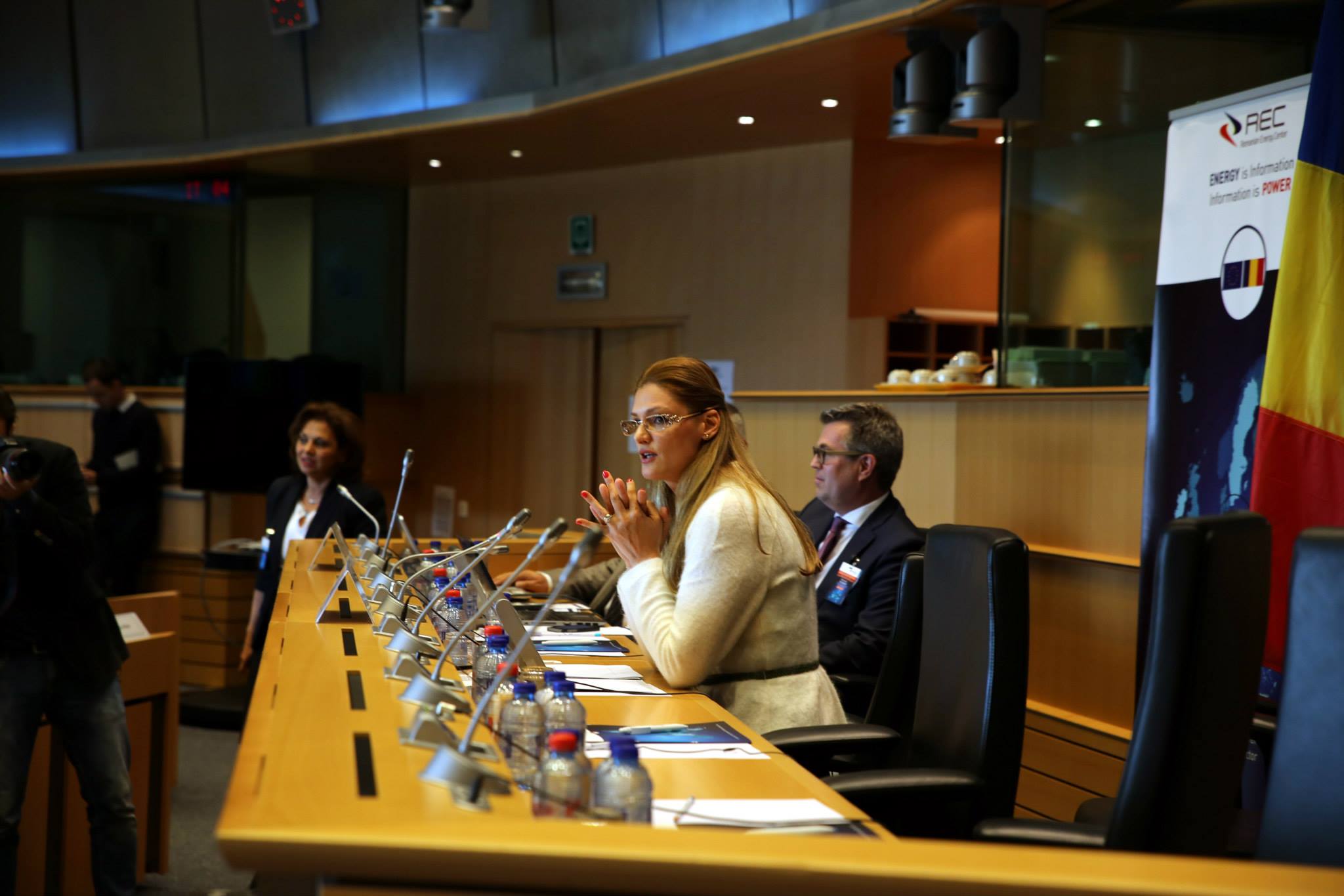
MEP Ramona Manescu (EPP) speaks in a post on the personal internet page about the opportunities and challenges that Romania faces during the exercise of its first rotating presidency of the Council of the European Union, focusing in particular on the diplomatic capacity and administrative capacity of our country to redefine its image and increase the prestige at European level during this unique moment. 
When discussing the opportunities presented by the Presidency of the Council, Ramona Manescu refers to the fact that Romania can demonstrate regional expertise on a number of key issues for EU unity and security, such as the fight against cybercrime, combating disinformation and fake news threatening the European elections in May which, as the Romanian experts have warned many times, are part of the hybrid war that originated in Eastern Europe, ensuring stability in the Black Sea region, both militarily and economically, and last but not least, energy security. Indeed, a successful presidency means a mandate whose balance sheet is positive regarding the legislative agreements concluded after the inter-institutional negotiations, mediated neutrally by the member state holding the rotating presidency of the Council, the Romanian MEP clarifies.
In this regard, she recalls the activity of managing key EU files in the first two months of mandate, in which the Presidency obtained the completion of 25 files only in February, in addition to the the successful Gas and Copyright Directives. Building on these results which amazed many Brussels officials, she says, the Romanian Presidency can strengthen its mandate further and prove it can be a trustworthy partner among the Member States.
On the other hand, the challenges Romania faces during the six month mandate, and referred to by Ramona Mănescu as having the potential to affect the image of the Presidency, are generated by the national political struggles that are projected in Brussels, the distrust expressed publicly by Romanian representatives regarding the institutional capacity of the Presidency Corps, but most importantly, by the possibility that Romania itself might miss to fully capitalize on the expertise and the human resources held.
For a more in-depth understanding of those submitted by MEP Ramona Mănescu, we fully reproduce her text:
”The Council of the European Union is a key decision-making body in the European structure, alongside the Parliament and the Commission. That is why the exercise of the Presidency of the Council of the European Union offers Romania the opportunity to bring national and regional priorities to the forefront, of course, in convergence with the European ones. It is also a unique opportunity for Romania to redefine its image and increase its prestige.
On the other hand, this mandate is a moment when Romania can permanently position itself, beyond doubt, at the heart of the European project as a serious, responsible and trustworthy partner. We need to demonstrate the capacity to handle large dossiers that outweigh the country’s borders.
Achieving the objectives assumed by Romania during its mandate equates to a successful presidency. Certainly, some of our goals favor Romania, our country profile happily fitting themes such as “improving the resilience of the Union to cyber attacks,” “fighting online disinformation and fake news” or “reaffirming the importance of the Black Sea region on the EU agenda, including from the perspective of revitalizing the Black Sea Synergy “.
In the two months since taking office, Romania has already made significant successes. Some would say that “it is a surprise from Romania to the European partners.” I say it is a confirmation of the real capacities that Romania has in the diplomatic and institutional field. The Gas Directive is by far the most powerful example. On February 12, a tripartite dialogue between the Parliament, the Council and the Commission resulted in a formal agreement on amendments to the Gas Directive. The provisional agreement with the European Parliament was obtained only two days after the Permanent Representatives Committee gave the Presidency of the Council the mandate to start the negotiations.
I have already said that Romania offers concrete and consistent examples of a successful mandate while holding the Presidency of the EU Council. But we must not forget where we started.
Just one year before we took over the presidency, we had seen an aggressive campaign against Romania. This campaign had intensified in the last three months of 2018. There had even been speculations that Romania would not take over the Presidency, although there was mechanism to do so. All media campaigns have had an impact on overall confidence. This is also because the general public does not know in detail the functioning of the institutional mechanisms.
The Copyright Directive is another file that had been on hold for three years. Romania has succeeded in obtaining the support of the EU Member States for a compromise text on this file and later the agreement of the European Parliament by taking two decisive steps towards closing the dossier, which only awaits the confirmation of Member States within the EU Council.
In fact, if we look today at the results of the Romanian Presidency, we will see at least 25 agreements concluded only in February! The themes are extremely diverse and practically cover virtually all areas of competence of the Council, from security to digitalization and from environment to financial markets.
Romania’s very good start in January and February, which we have all witnessed, makes us even more compelled in the coming months. A successful Presidency is noticed when it proves a number of qualities and has a positive final balance sheet. Although the country holding the Presidency is always changing, it has a permanent and unique character. That is why coordination and continuity between the countries holding the presidency, between the people involved in the Presidency and the various Council formations are essential. This coordination and collaboration should take place not only between Brussels and Bucharest, but also between the central authorities.
The presidency must be neutral and impartial. This is because it can neither favor the interests of other Member States nor push national preferences before European ones.
The Presidency can not be politicized. Such an approach would undermine the capacity and performance of the Presidency, to the detriment of both Romania and the European Union.
It is essential not to fall into the sin of moving the internal political struggle from Bucharest to Brussels. Making Romania a special case, in the context of the Presidency, definitely undermines our chance of being on an equal footing with others. And I firmly believe that the Romanians deserve this chance offered by the Presidency of the EU Council to be treated with more respect.”