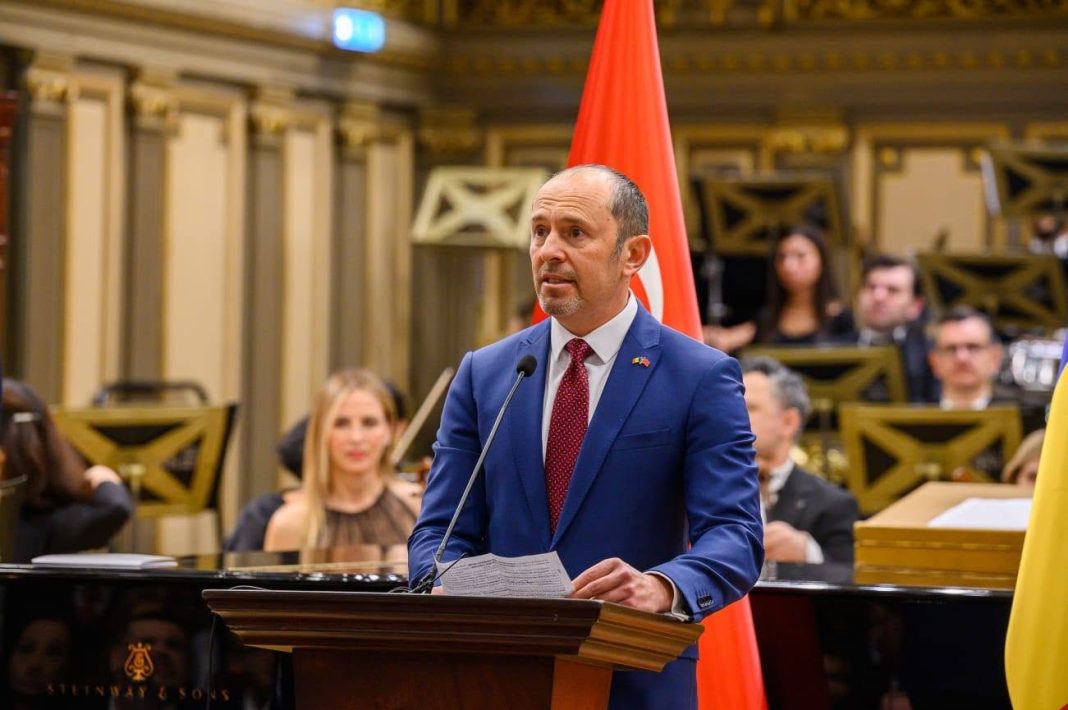
Türkiye, Romania and Bulgaria intend to sign, on the sidelines of the NATO Summit in Ankara, a new agreement that would expand the trilateral MCM Black Sea operation from mine countermeasures missions to the protection of critical underwater infrastructure in the Black Sea, including energy projects such as Neptun Deep, Türkiye’s Ambassador to Romania, Özgür Kıvanç Altan, said in an exclusive interview with CaleaEuropeană.ro. In the interview, he stressed that, amid tensions between U.S. President Donald Trump and several European allies over defense spending and the future of the transatlantic relationship, Türkiye is relying on the personal relationship between President Recep Tayyip Erdoğan and the White House leader to help strengthen NATO unity at the Ankara Summit. Altan believes the summit will take place at a moment when NATO is “rethinking how it can function better as an Alliance”.

“We are going through critical times, and our Alliance is going through critical times as well. This summit is taking place at a moment when we are truly rethinking how we can strengthen the Alliance,” Özgür Kıvanç Altan said. In his view, Europe must strengthen its own military capabilities within NATO without weakening Allied cohesion, while increased defense investments must be translated into real military capabilities and a stronger defense industrial base.
Referring to Donald Trump’s participation in the summit, the ambassador insisted that the close relationship between Presidents Erdoğan and Trump represents an asset for the entire Alliance. “Our President, Recep Tayyip Erdoğan, is a world leader… He has a very good, sincere and genuine relationship with President Trump. If this is to the benefit of our Alliance, then it is a wonderful thing. We will make use of this closeness. The ultimate purpose of the summit is to reaffirm and reinforce the strength of our Alliance and the strength of the transatlantic bond,” the diplomat said.
The interview also addresses Romania’s strategic role in the Black Sea security architecture. The Turkish ambassador describes Romania as “a critical ally” for Türkiye and confirms that Ankara seeks to expand trilateral naval cooperation with Romania and Bulgaria by including the protection of underwater energy infrastructure and critical communications networks. According to him, the new agreement on the expansion of MCM Black Sea is expected to be signed on the margins of the NATO Summit in Ankara, reflecting the three allies’ shared interest in Black Sea security and in protecting strategic energy investments in the region.
CaleaEuropeană.ro: The upcoming NATO Summit in Ankara is being described by some analysts as a defining moment for the Alliance. From Turkey’s perspective, what are the main objectives and expected outcomes of this summit, particularly regarding the security in the Black Sea region and NATO’s adaptation to a more contested international security environment?
Özgür Kıvanç Altan: We are going through critical times and our alliance is going through critical times. So this summit is coming at a time that we are really rethinking how we can better do with our alliance. There are of course some very important discussions as we witnessed in the last couple of years about NATO and about the security environment that concerns NATO. We have some key objectives.
The first one is to reiterate and reinforce allied solidarity and to indicate the importance of the solid foundation that we have for the transatlantic link – U.S., European. This is very important. Most of the time in the past, this was just regular text in the communiqué language. But this time, as ever, is going to be very important. We have to secure this.
Of course, there is a big discussion on burden sharing. We need to strengthen the European pillar inside NATO, not separately, not EU doing its own thing, but rather European allies strengthening their defence posture. We have to make sure also this summit oversees the fact that are we spending enough for defence. And more importantly, is this expanded defence expenditure translated into defence capabilities. Are we making smart investments? We will see all of this.
One of the important things for all of us, and definitely for Türkiye, we need to have a 360 degree approach to security. We cannot be a single topic Alliance because life is more complicated than that. Security environment is not a single topic. And we, as Turkey, we knew this firsthand because we’re living this firsthand.
And also, of course, it’s about Ukraine, to continue the support for Ukraine. There is an agreement and a strong consensus in the Alliance for this, because we never agreed with this war. We support Ukraine’s sovereignty. We support Ukraine’s territorial integrity. We support Ukraine’s dignity. But also, we support a peace deal.
We, most of the time, think that we’re not talking enough about peace, about diplomacy. This is what Türkiye is bringing to the table. We have also a good line of communication with the Russians.
And eventually, it will have to be a peace deal. So all of this is coming together in my hometown, Ankara. And rest assured, we’re not only hosting this from a logistic perspective.
We’re hosting this inside and out. And, of course, there are lots of social media posts showing Mr. Trump saying that he’s coming because this is hosted by our president. And they have a very good line.
It’s important that we use our standing point, our hard power and soft power to bring all these issues and our great alliance together strong out of this summit.
CaleaEuropeană.ro: Since you mentioned the fact that we should have a more strong European pillar within NATO, we’ve seen this phrase from different leaders that mention a more powerful Europe in a powerful NATO. Well, the United States refers to this as NATO 3.0, where Europe takes the helm of its conventional security while the United States still preserves the strategic stability role that it has through its nuclear deterrence. How does Turkey interpret this concept of NATO’s 3.0? And what role do you see for regional powers, such as Turkey, but also for Romania as a viable ally here in the Black Sea in shaping this next phase of NATO?
Özgür Kıvanç Altan: This is a good idea. Whatever you call it, it’s also a fancy name, 3.0, but maybe actually it’s back to 1.0. This is what it should have been. I think most European countries, they relaxed a lot during the last couple of decades. But the world is not a place as such. We still have very difficult security challenges, so we need to go back to the essentials, back to the situation in which all European allies are able to defend first themselves because first, every ally for themselves, and then for every ally to be in solidarity with other allies. And of course, this is more than rhetoric. To be able to do all of this, you need to spend, you need to have a solid defense expenditure. More important than that, capability. And for capabilities, you need to have a solid defense industrial basis.
And as Turkey, we have been really investing in this for the last 50 years. First of all, we are located in a place that does not ever let us to lower our guard. But also, Turkey, of course, is a democratic nation, but also we’re a military country, and we’re proud about this.
So all of this is very relevant for us. We’re ready to do this work. If we call it 3.0 or back to 1.0, we’ll do it.
CaleaEuropeană.ro: Relations between some of the European allies and the U.S. President Donald Trump have a time marked by tensions right now, of course, because burden-sharing defense priorities, U.S. operations in Iran, and the support coming or not coming from European allies. And just yesterday, U.S. ambassador to NATO said that European allies are lagging behind on defense spending, while praising Turkey for its defense industry capacity. And we’ve seen this also with the ship that you provided to Romania just a few days ago, and we can see it here in a small version. What do you think there will be key deliverables and announcements made at this summit when we regard to defense spending and also defense capabilities in order to preserve unity among allies?
Özgür Kıvanç Altan: First, we’ll have to look how we did for keeping up with the decisions of the Hague Summit from last year. All of us, we promised that in a certain time, we will reach 5% of GDP for defense spending. This is not only to be done in one year. This is towards 2030. But how did we do in the last one year? Were we able to come close to our objectives? And to be honest with you, this is actually not new. This is actually what NATO has been doing for decades. There is a concept of defense planning, and within defense planning, there are targets, and every couple of years, there is a very close look at how each ally is doing individually in reaching these targets, and also how collectively we did. So most probably, coming out of this summit, there will be a decision to take a look in the next six months, one year, on what have we done and where should we be leading. And of course, here, Turkey-Romania relationship is critical, is essential for within the alliance, but also bilaterally for the Black Sea security, because we are really 50 minutes apart from each other. Our defense industry cooperation is of critical importance. Turkey sees Romania as a critical ally, and also a Black Sea neighbor, and we are ready to do such projects together, which actually no allies do.
CaleaEuropeană.ro: We know that President Trump has recently emphasized while meeting NATO Secretary General his disappointment of European allies, as I mentioned before, but that he will attend this summit, as you mentioned, because of President Erdogan or out of respect for President Erdogan. Does this put a pressure on you as a host? Depending on what will you call this summit a success or a failure, considering that last year, well, Donald Trump had a good summit because of the 5% commitment, but also because he was hosted by the king and the queen of Netherlands?
Özgür Kıvanç Altan: This doesn’t put a pressure on us. But it gives us motivation to work hard to host the summit. Our president, Recep Tayyip Erdogan, he’s a world leader, and he’s not a world leader just now. For a quarter of a century, he’s a respected, revered world leader, making a great contribution to stability around us, to solidarity and unity within the alliance. He has a very good and sincere, genuine relationship with President Trump. And if this is to the benefit of our alliance, that’s a wonderful thing. And we will use this body language. And the purpose at the end of the summit is to reinforce, reiterate the strength of our Alliance, the strength of our transatlantic bond. This is, in a sense, the scope, and we will do it.
CaleaEuropeană.ro: Coming back to Romania and the Black Sea, on June 20, just two weeks ago, President Recep Tayyip Erdogan and President Nicușor Dan reaffirmed the strategic partnership between Romania and Türkiye in Istanbul. What concrete deliverables can we expect from this renewed political relationship, considering that this year will also mark 15 years of strategic partnership?
Özgür Kıvanç Altan: We have an amazing basis between Türkiye and Romania. When Romania was out of the revolution, Türkiye was one of the first countries to open its doors to Romania. I’m always moved when my Romanian friends, they tell me that after the revolution, the first city, the world city that they visited after the revolution was Istanbul. Türkiye was one of the first countries to give a strong backing to Romania for its NATO membership, while there were some doubts among other countries. Over the years, we developed a bilateral relationship based on trust, long-standing history, common culture, and the commonalities that bring us really together. In 2011, this was crowned by our strategic partnership, and it’s been 15 years. We are doing so much in every domain. You would be surprised how much Turkish investment there is in Romania, and it’s not in finance mumbo-jumbo, it’s in the real economy. You go out of Bucharest, in Ilfov, in Arges, in Ploiești, in Craiova, in Dobrgea, you can see what kind of contribution our businesses are making to Romanian industry, exports, labor markets. We have also a giant economic basis. Our trade volume is approaching 15 billion dollars, which is huge. So our human-to-human contacts, this is wonderful.
We have the Turkish and Tatar community living in Dobrogea in peace, and Romania never approached these people with suspicion. Only with a very progressive approach, giving them all the space to express themselves in religion, language, way of life, traditions, and this really gave Turkish businesses and the Turkish state a great confidecen that Romania is a very important partner for us at a very important location.
That’s also fueling our strategic partnership when it comes to security, when it comes to Black Sea security, what we can do together, what we are doing together, and what can be more.
Already we show a lot of solidarity with Romania. Our F-16s are coming for NATO enhanced air policing. They were here in 2024, they will come again at the end of this year. We take part in Eastern Sentry, we take part in all the important exercises. Every 15th of August we bring our warships for solidarity with Romania in the Naval Forces Day, which is one of my favorite days throughout the year. And, of course, the joint operation that we’re conducting in the Black Sea, which is called MCM Black Sea.
CaleaEuropeană.ro: President Nicușor Dan announced plans to expand this MCM Black Sea cooperation to the protection of maritime and submarine infrastructure. How does Türkiye view this initiative, and what practical measures could be implemented to protect critical energy and communications assets in the Black Sea? Do you think that measures like this could be agreed on the margins of the Ankara NATO Summit? And how can Turkey contribute to this?
Özgür Kıvanç Altan: Black Sea security is dear to us. I know it’s very important for Romania, but it’s equally important for Turkey. We believe that through our regional cooperation, particularly among the three NATO allies, we take ownership, from our perspective, the security in the Black Sea. This is our biggest tool, what we can do together.
This is supported by the Montreux Convention because the Montreux Convention was signed in 1936 and it makes Turkey the gatekeeper. And thanks to our vigorous implementation by spirit and letter of this convention, the maritime zone in the Black Sea is now not a big battle zone. Yes, we see disturbances from time to time, but thanks to our implementation of Montreux Convention, we don’t see much war. But, of course, we still need to keep an eye on what’s going on, on the challenges over there.
We have some stakes. Energy stakes, economy stakes, of course, liberty of navigation. From the point of view of energy, we have the Sakarya Basin. We have a huge amount of gas, which we already tapped into. So Turkish households are now using this. And we’re going to redouble, triple our production. And next year, in Romania, Neptune Deep is coming into service. So this is really important. That makes us having a very important common interest. We know that Bulgarians, they do have a basin. So this is also important for us.
We already started in 2024, this MCM Black operation. This was for mine clearance and observance. This worked out very well. It was very fruitful. First, they didn’t really address the mine challenge. But maybe more importantly, they really learned to interoperate.
And interoperability is a key concept under our alliance. So now, the purpose, hopefully, next week at the Ankara Summit, is to sign a new agreement, Turkey, Romania, Bulgaria, to expand the scope of MCM Black, to include, still, mine clearance, but also protection of critical underwater energy infrastructure. This is our common interest.
CaleaEuropeană.ro: This includes also energy projects like Neptune Deep?
Özgür Kıvanç Altan: Yes.
CaleaEuropeană.ro: Romania has expressed interest in hosting the Black Sea Combined Task Force (CTF-Black Sea) command structure in Constanța when the rotational command passes from Türkiye in 2028. What significance does Ankara attach to this transition, and how could this help the principle of regional ownership within NATO when it comes to security in the Black Sea?
Özgür Kıvanç Altan: Exactly, you put it right, because this was a fruitful outcome of the regional ownership discussions within NATO. We have now the turn at the moment. And there is agreement on the NATO documents that this is going to be on a rotational basis, and we’re okay with this, as long as the host nation has the necessary military capabilities to do this. Because it’s not only just an office. You need some capabilities, some technical military capabilities to be doing this. And we are sure the discussions are ongoing now among the littoral allies. So we are confident that this will come to complete fruition.
CaleaEuropeană.ro: Mr. Ambassador, thank you for this interview!
Özgür Kıvanç Altan: Thank you!